- What Is USMLE? Definition and Purpose
- 2025–2026 Update
- Purpose and Function of the USMLE
- 2025–2026 Update
- USMLE Structure 2026
- Step 1 at a Glance (Pass/Fail)
- Step 2 CK at a Glance
- Step 3 and CCS at a Glance
- Test Day Overview (Prometric)
- 2025–2026 Update
- The IMG Pathway to Residency (2026 Roadmap)
- 1. Initial Evaluation and Timeline Planning
- 2. ECFMG Certification and Document Verification
- 3. Professional English Proficiency (If Needed)
- 4. Exam Preparation and Testing
- 5. Clinical and Research Experience in the U.S. (Optional but Valuable)
- 6. Application Preparation
- 7. Application Submission and Interview Season
- 8. Ranking and NRMP Match
- 9. Visa & Entry Procedures
- 10. Steps After Starting Residency
- Glossary
- LoR (Letter of Recommendation)
- SOAP (Supplemental Offer and Acceptance Program)
- 2025–2026 Update
- Registration, Test Centers, and Fees
- 2025–2026 Update
- Ready to Start Your USMLE Journey Seriously?
- Frequently Asked Questions
What is USMLE? The United States Medical Licensing Examination (USMLE) is a three‑step US medical licensing exam designed to evaluate physicians’ scientific knowledge and clinical readiness for medical practice in the United States. In this 2026 guide, we review the overall USMLE structure, from Step 1 (Pass/Fail) to Step 2 CK and Step 3, including the clinical simulations used to assess real‑world decision‑making. We also explain the purpose of the USMLE and how this exam functions as the medical licensing exam in the United States. In addition, we briefly discuss the role and validity of the USMLE in the US medical system and how it influences the path toward residency. This page provides a general roadmap, while detailed information about registration, exam fees, and test centers will be covered in separate articles.
2025–2026 Update
In recent years, the evaluation process has changed following the shift of USMLE Step 1 scoring to Pass/Fail. As a result, residency programs now assess applicants differently. While this guide provides an overall overview, in 2025 and 2026 many programs place greater emphasis on Step 2 CK performance, the history of exam attempts, and the overall consistency and strength of the residency application profile.
What Is USMLE? Definition and Purpose
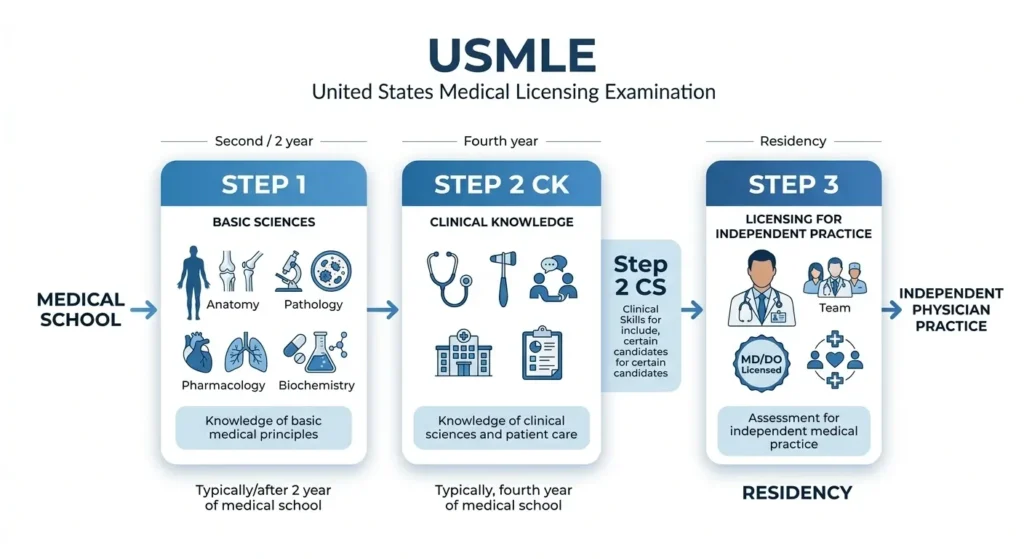
What is USMLE? The United States Medical Licensing Examination (USMLE) is a standardized series of three national exams designed to assess physicians’ scientific knowledge and clinical competence. It serves as the foundation for obtaining a medical license in the United States. The USMLE exam is neither an academic degree nor a substitute for residency training; instead, it provides a unified benchmark to ensure physicians meet a minimum standard of medical competency before entering specialty training programs.
The results are reviewed by state medical licensing boards and residency programs. Both U.S. medical graduates and international medical graduates (IMGs) are required to pass it. IMGs must also obtain additional certifications, which are explained in separate pages. In simple terms, the US medical licensing exam acts as a “standardized filter”: it evaluates scientific foundations, clinical judgment, and safe decision‑making to ensure that entry into the U.S. healthcare system is consistent and comparable.
2025–2026 Update
In practice, the USMLE is not merely a pass‑or‑fail requirement but part of a broader evaluation of an applicant’s profile. Residency programs often consider factors such as the time gap between Steps, the number of exam attempts, and how well the scores align with the other components of the residency application.
Purpose and Function of the USMLE
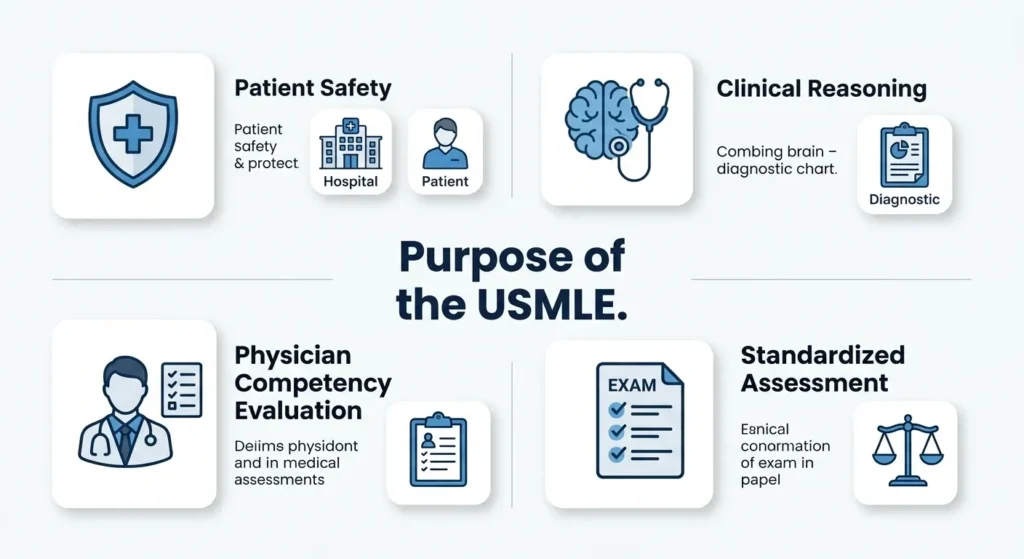
The USMLE is a national assessment tool designed to ensure that physicians possess the minimum theoretical knowledge and clinical skills required before entering the U.S. healthcare system. The purpose of the USMLE includes several core functions:
- Establishing a Standardized Benchmark: It allows for a fair comparison of candidates coming from different medical schools and various countries.
- Ensuring Patient Safety: By assessing clinical decision-making and professional responsibility, it ensures that only competent physicians practice medicine.
- Legal Foundation for Licensing: It provides the necessary legal basis for state medical licensing and international certification processes.
- Residency Screening Tool: It assists residency programs in the initial screening of applicants and the selection of candidates for interviews.
- Defining a Structured Learning Path: The exam maps out a progressive learning journey—from basic sciences and system integration to real-world patient management.
Important Note: Although USMLE Step 1 is now reported as Pass/Fail, the combination of performance in Step 2 CK and success in Step 3 remains a decisive factor for residency programs and licensing boards. This page provides a general overview; specific details regarding certification for international graduates and state regulations are covered in related articles.
2025–2026 Update
In recent Match cycles, Step 2 CK has effectively become the primary standardized numerical score used to compare applicants nationwide. Many residency programs now utilize unofficial “cut-off” scores, making the Step 2 CK score a critical factor in receiving interview invitations.
USMLE Structure 2026
The United States Medical Licensing Examination (USMLE) is a comprehensive, three-step pathway that progresses from evaluating foundational medical sciences to assessing clinical decision-making in real-world settings. This section provides an overview of the USMLE structure 2026, while detailed information is available on the dedicated pages for each step.
Step 1 at a Glance (Pass/Fail)
- Focus: Integrates basic sciences with early clinical concepts.
- Objective: The USMLE exam at this stage tests conceptual understanding rather than rote memorization.
- Result: Reported as Pass/Fail.
- Learn more about the purpose of the USMLE Step 1 and study resources in our “Step 1 Details” (/usmle/step-1/) guide.
Step 2 CK at a Glance
- Focus: Evaluates clinical judgment, diagnostic prioritization, and patient management.
- Importance: For most residency programs, this is considered the most significant performance signal within the role of USMLE in the US medical system.
- Find comprehensive descriptions and study schedules in our “Step 2 CK Details” (/usmle/step-2-ck/) guide.
2025–2026 Update:
Currently, Step 2 CK is the primary numerical indicator of a candidate’s performance in the Match process. As part of the USMLE validity and recognition landscape, strategic planning regarding exam timing and target scores is essential.
Step 3 and CCS at a Glance
- Focus: Assesses the ability to make independent decisions in patient care.
- Format: Includes written items and Computer-based Case Simulations (CCS).
- Review technical and strategic tips in our “Step 3 and CCS Details” (/usmle/step-3/) guide.
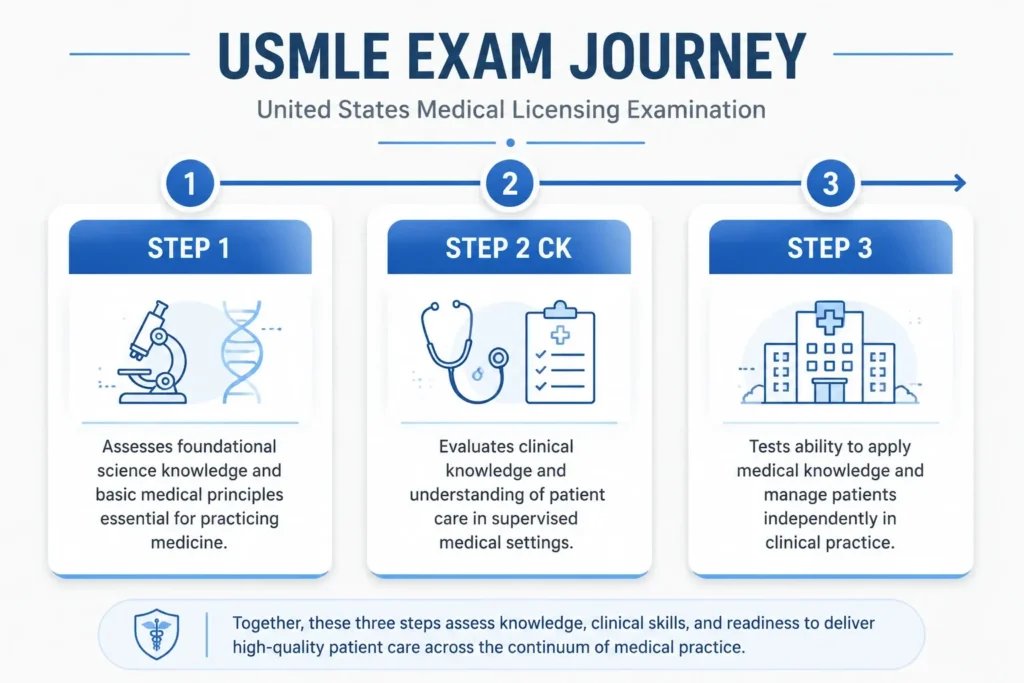
By understanding the US medical licensing exam structure, you can better navigate your journey. Remember that What is USMLE is just the beginning—successful navigation of the United States Medical Licensing Examination is a long-term commitment to professional excellence.
Test Day Overview (Prometric)
On the day of the USMLE exam, candidates enter a strictly controlled and standardized environment designed to protect the integrity and validity of the United States Medical Licensing Examination. Check‑in is performed in several steps, including identity verification, a brief physical inspection, and storing all personal belongings in a locker. Only an approved form of identification and permitted items may be brought into the testing area.
The testing room is monitored by cameras and an on‑site proctor, and each examinee is seated at an individual workstation. Break time is managed as pooled (combined) break time, which you can divide across your exam blocks. Completing the tutorial early typically adds extra minutes to your break pool. Any exit from the testing room must follow Prometric regulations, and re-entry requires another security check. If you need to reschedule your test date for any reason, the rules and associated fees are explained in the registration and cost guide. For the full list of required documents, allowed items, and additional test‑day details, refer to the official Test Day Rules Guide.
2025–2026 Update
In many Prometric centers, identity verification procedures, biometric checks, break‑time management, and re‑entry inspections have become more strict. Failure to follow these procedures may result in an Incident Report, which can affect your USMLE recognition and exam record.
The IMG Pathway to Residency (2026 Roadmap)
For international medical graduates (IMGs), entering the U.S. healthcare system involves document evaluation, certification requirements, passing the US medical licensing exam, preparing a strong application, and completing the Match process. The roadmap below provides a practical overview; each step is explored in detail in specialized articles.
1. Initial Evaluation and Timeline Planning
Review your medical degree status, transcripts, internship history, and specialty goals. Create a realistic 12–18‑month timeline.
2. ECFMG Certification and Document Verification
Register with ECFMG, upload and verify credentials, and follow up with your medical school. Some applicants may need alternative certification pathways. Full details are in the “What is ECFMG?” guide.
3. Professional English Proficiency (If Needed)
Prepare for and take OET Medicine, ideally in parallel with other steps so you are ready for application season.
4. Exam Preparation and Testing
Study sequentially for Step 1 (Pass/Fail) and then Step 2 CK, focusing on clinical judgment. Step 3 is typically taken during or near the start of residency. These exams form the backbone of the USMLE exam pathway and are central to the purpose of the USMLE within the U.S. medical system.
5. Clinical and Research Experience in the U.S. (Optional but Valuable)
Pursue USCE opportunities such as observerships, externships, or research to strengthen your application and secure relevant recommendation letters.
6. Application Preparation
Develop a professional CV, write your Personal Statement, gather Letters of Recommendation (LoR), obtain transcripts, and ensure official submission of exam scores through ERAS.
7. Application Submission and Interview Season
Apply to suitable residency programs, manage signals, track communications, practice interview skills, and attend interviews.
8. Ranking and NRMP Match
Submit your rank order list after interviews. Match results are released afterward. If you do not secure a position, the SOAP process opens for unfilled spots.
9. Visa & Entry Procedures
Depending on program requirements, apply for the appropriate visa and complete onboarding for the start of residency.
10. Steps After Starting Residency
Complete Step 3 within the required timeframe, progress through residency, and work toward board certification and full state licensure.
Glossary
LoR (Letter of Recommendation)
A formal letter written by a faculty member or clinical supervisor confirming your academic ability, clinical competence, and professionalism. Most applicants need 3–4 letters, ideally with at least one from U.S. experience. Letters are submitted through the ERAS LoR portal—preferably with the “Waive” option for higher credibility. Request letters early (6–8 weeks in advance) and provide your CV and key highlights to guide your writer.
SOAP (Supplemental Offer and Acceptance Program)
A rapid, structured alternative during Match Week for applicants who are unmatched or partially matched. Available only to eligible candidates in NRMP and ERAS. Programs send residency offers in several rounds. Direct communication with programs is limited; applicants must update documents quickly and submit responses within each round’s short time window.
2025–2026 Update
-
Ready-to-submit documents, fast responses during each SOAP round, and targeted program selection have become significantly more important.
-
SOAP has become more competitive in recent years, with many programs reviewing only applications that include strong Step 2 CK performance, real U.S. clinical experience, and fully completed documentation.
This page provides only the high‑level roadmap. Individual sections—ECFMG certification, OET Medicine, USMLE Step preparation, ERAS application, Match, and SOAP—are each covered separately in detailed, step‑by‑step guides.
Registration, Test Centers, and Fees
For international medical graduates, the practical process begins by creating an account and completing your profile on the official portals. After that, you select your eligibility period, and once approved, you can schedule your USMLE exam at one of the Prometric centers. Choosing the right testing region should be based on flight accessibility, personal scheduling needs, center capacity, and the experience of past candidates.
Each step of the United States Medical Licensing Examination has its own base fee, and taking the exam outside the United States includes an additional international services charge. Rescheduling fees vary depending on how close you are to your exam date. To avoid errors or unnecessary delays, review the detailed pages carefully and follow the official links for registration, center lists, regional selection, and fee schedules:
Registration Guide, Test Centers and Regions, and Fees 2026.
This page provides only a high‑level roadmap; the step‑by‑step instructions and official updates are maintained in the connected articles.
2025–2026 Update
Due to increased demand in certain regions, it is recommended to reserve Prometric test centers early to avoid capacity limitations.
Ready to Start Your USMLE Journey Seriously?
If you’ve decided to prepare for the USMLE, having a clear roadmap, the right resources, and a solid study strategy can make all the difference.
That’s exactly why we’ve designed a Comprehensive USMLE Preparation Course, built directly around the real structure of the exam and the needs of medical applicants — taught by Dr. Oveis Salehi, one of the most recognized instructors in this field.
To date, more than 5,000 students have taken his courses and successfully passed various stages of the USMLE exam, moving forward on their residency path.
In this course, you will learn:
• How to create an effective and targeted study plan for Step 1 and Step 2 CK
• Which core resources and question banks are truly worth your time
• How to analyze USMLE exam questions and manage your time just like test day
If you want to explore the full course details, syllabus, and enrollment information, visit the page below:
👉 View the Comprehensive USMLE Preparation Course
Frequently Asked Questions
What Is USMLE and Why Is It Required?
What is USMLE? The United States Medical Licensing Examination (USMLE) is the US medical licensing exam designed to evaluate physicians’ scientific knowledge and clinical competence through three standardized steps. Its purpose is to ensure a safe and comparable pathway into the U.S. healthcare system. USMLE results are used by state medical licensing boards and residency programs to assess applicants, making the exam equally important for both U.S. and international medical graduates.
What Is the Difference Between Step 1, Step 2 CK, and Step 3?
Step 1 focuses on the integration of basic sciences and is reported as Pass/Fail.
Step 2 CK evaluates clinical knowledge and clinical judgment and is considered by many residency programs to be the primary indicator of academic performance.
Step 3 is a two‑day exam that includes both written questions and Clinical Case Simulations (CCS) to assess a physician’s ability to make independent medical decisions.
Is Step 1 Pass/Fail and What Impact Does That Have?
Yes. USMLE Step 1 is now reported as Pass/Fail. This change has shifted the focus of many residency programs toward Step 2 CK performance. However, a strong understanding of Step 1 concepts remains essential for success in Step 2 CK and for long‑term progress in the USMLE pathway.
Where Can You Take the USMLE Exam?
Step 1 and Step 2 CK can be taken at international Prometric testing centers, and the choice of testing region should be based on accessibility, seat availability, and scheduling considerations. Step 3 is administered in the United States and is usually taken after starting residency or close to the beginning of residency training.
How Long Are USMLE Results Valid?
In practice, the validity of USMLE results depends on the policies of individual state medical licensing boards and the requirements of specific residency programs. Some jurisdictions set time limits for completing all exam steps or place importance on how recent the results are. Therefore, after understanding the general pathway, you should review the regulations of your intended destination through official sources and follow the detailed information provided in the registration, test centers, and fees pages.